Showing posts with label Abe Kobo. Show all posts

Friday, 18 September 2015

The Ark Sakura by Kōbō Abe


The Ark Sakura/Hakobune sakura maru first appeared a little over thirty years ago, translated by Juliet Winters Carpenter the novel displays a number of motifs that can be seen in much of Abe's writing, although laced in places with absurdist humour the novel addresses a number of sociological issues, although chiefly among these is the prospect of nuclear armageddon, told with a particularly Abe-esque vision. The novel opens with it's narrator Pig or Mole as he prefers it, buying an eupcaccia, an insect invented by Abe which back in pre-internet days must have convinced many readers that it was a bona-fide insect, Mole identifies with the insect through numerous instances of the novel, (the fact that the insect feeds on it's on faeces is a slightly disarming one), which gives the novel an entomological strand, similar to that perhaps also felt in The Woman of the Dunes, through the bug's purchase at a rooftop sale he comes into contact with three other principal characters of the novel, the insect dealer, the shill and his girlfriend, whose real name Abe, I'm certain doesn't let slip throughout the book. After buying the insect Mole learns that the previous purchasers, the mole and his girlfriend were in actuality fake buyers, shills, employed by the market to entice customers into making purchases, they're are also known as sakura and later refer to themselves as decoys, which goes some way in being an initial driving pin Abe utilises in beginning to separate reality and appearance, which one might be real?, later in the novel this concept is added upon when we are presented with the scenario that it's protagonists are happier to live in a world of supposed nuclear destruction than existing in the world that they had known previously to it. In some ways The Ark Sakura could be seen as Abe's end of the world novel, the only one Abe wrote during the eighties it's evocative of it's own age, appearing a year before Murakami's Hard Boiled Wonderland and the End of the World it feels at times like there are a number of overlaps in tone between the two writers, although where as Murakami leans to use magical realism in his writing it feels that Abe's writing presents the imagery but leaves the reader open to ponder on what is being presented. Amongst the political satire and at times coded commentary the novel studies some serious concerns, notably that of the concept of collective fear in the nuclear age, when reading the novel we have to remind ourselves of the proximities of these fears in the age it was written, the tangibility of nuclear Armageddon.

A good first portion of the novel is taken up with following Mole persuading the insect dealer, the shill and his girlfriend into signing up in being crew members to board his ark built in a disused quarry, once owned by his father, the exact dimensions of the ark remain uncertain, and as they wander the labyrinthine tunnels of the ark we're reminded of the winding corridors of the hospital in Secret Rendezvous, Mole and the insect dealer are uncertain as to whether they've made it to the ark before the shill and his girlfriend, as they are separated en route, there's an epiphanic scene in the darkness after they arrive when Mole switches on the light, via one of his strange gadget inventions, that throws the novel into a light that somehow doesn't feel was on before, we begin to learn of the shades of Mole's character, his estranged father Inototsu, and that Mole was the product of a rape committed by his father. Once inside the ark the narrative, usually conveyed via Mole explores various philosophical and social subjects, at one point the notion of national sovereignty is examined and the conclusion arises that on the whole it's a rather limp concept which exists in order to allow the state to remain free reign do as it wishes. Whilst in the ark we learn that other factions operate within the quarry, an octogenarian group of cleaners called the Broom Brigade have formed their own quasi political group, which it could be said resembles a certain faction that drive around in darkened vans, this portrait feels similar to Abe's continued coded commentary of the right as in The Ruined Map the criminal gang are all wearing yamato badges, it's not too obvious, although it is there. As well as the political ruminations there is the background subplot of the quarry being targeted to dump toxic waste illegally for profit, which is the point of contention between Mole and the varying factions, and also of the quarry being a place to despatch the bodies of unwanted persons who find themselves in the way. Abe's metaphors seem to resonate and become more cohesive after coming to the end of many of his novels, they sometimes come into focus later, which leads us to contemplate his use of perspective in his narratives. Another group referred to is the Olympic Preventive League, which has perhaps a renewed relevancy in light of future events, Mole contemplates the event noting it's absurdity and the means of what it represents.

As with some of Abe's later novels it feels that at times the plot line of The Ark Sakura unfurls in a scattered way, there is subterfuge and digressions, the flow of the narrative is pockmarked by allegorical incidence and odd angled diversions. As well as the serious line of the narrative this feels like it is threatened to be subsumed by Mole's observations of his attraction to the shill's girlfriend although this goes someway in exacerbating the sense of his solitude, another aspect of his character alluded to is the inherent criminality passed between father to son. Off centre in the later half of the novel a death occurs whose circumstance Mole can't unfathom, it's left there, a dark knot in the novel that even the narrator cannot seem to undo, it's interesting also to contemplate that the novel has two exit points to speak of, Mole's escape and of those that stay behind. It's also interesting to contemplate that the novel appeared in 1984, obviously a significant year in literature, which provokes the question of Abe's thoughts on Orwell's novel, surely he must have read it?, did he write on it?, another further point of interest is that 1948 was the year that Abe's first piece appeared, curious observations that probably have no connection.      

The Ark Sakura at Penguin Random House 


Saturday, 2 June 2012

The Ruined Map


Whilst reading Kobo Abe's novels it's almost impossible not to visualize them being enacted out in black and white, the details of the scenery, the descriptions of roads and cityscapes, the people in them, any piece of descriptive prose one imagines in black and white. The Ruined Map/ Moyetsukita chizu is probably one of the least known adaptions of Abe's novels by Teshigahara Hiroshi, it is in fact the only adaption that was filmed in colour, although as of yet the film hasn't seen a release outside of Japan, in Japan it is included in a boxset of Teshigahara's movies that has recently been released. The novel was translated by E. Dale Saunders, beginning an Abe novel the reader at first finds themselves getting to grips in searching out the parameters of the story, and in as much as Abe's novels depict an expansive landscape of the imagination, the impression that they operate within a confined space is often difficult to shake off. After the preliminary plot line has been established the reader simply has to wait and look for the moment or clues that things are going to start to shift out of the framework Abe has set up, it's this moment that I think that always draws me back to reading his novels and writing. The Ruined Map is a detective novel in more ways than one, Nemuro Hiroshi, head of sales of a large company, (Dainen Enterprises), has been missing for six months, at his brother in-laws instigation his wife hires a detective in an attempt to track him down. The novel is presented from the perspective of the detective, and visiting Nemuro's wife he finds that since his disappearance she has slipped into alcoholism, the contents of her apartment are described in a way that turns every object into a clue worthy of the most scrupulous suspicion, a motif that appears whenever the detective returns to the wife's apartment is the lemon yellow curtains, it appears as one of the most reliable features that the detective can rely upon.

The detective's investigation is pitted against evasion, the brother in-law insists that he start the case from the beginning and refrains from proffering any of the information that he has gathered. Initially all the detective has to go on is a photograph and a box of matches with a phone number on it, which in turn leads him to the Camellia coffee house. Returning to Dainen Enterprises puts him into contact with Tashiro whom Mr Nemuro was meant to meet with the day he disappeared, Tashiro begins to lead the investigation into stranger waters which are later revealed to be not what they seem, and draws the map of where he was meant to have met Nemuro. As the case progresses the detective begins to learn that Mr Nemuro and his brother in-law are involved in what appears to be a criminal organisation called the Yamamoto Association, involving blackmail and prostitution, obviously a subtle insinuation in the name of the association. The detective wrestles with suppositions of the motives of Nemuro's disappearance, and at times the detective's circumstance resembles those of Nemuro. The novel is devoid of the metaphor seen to the extent in The Woman in the Dunes/Suna no Onna and perhaps lacks the cryptic symbolism of Secret Rendezvous/Mikkai, but themes that feature in Abe's writing are apparent here. Towards the end of the novel the detective appears to suffer an amnesiac breakdown, the demarcations of his individuality begin to slip away, but as with much of Abe's writing this does not in turn to describing the collective consciousness, but acts as a stripping away of the superfluity of the individual. The novel is dotted with instances where the detective observes the anonymous mass, people on the move each searching for their individual goals, Abe's novels carry many subtexts, and here he seems to be looking into the unconscious nature of the aspirations of the modern individual, the map that Tashiro had drawn for the detective acts as a perfect template for Abe to explore many notions of this loosing of direction, or location.

The Ruined Map at Vintage International
       

Thursday, 30 June 2011

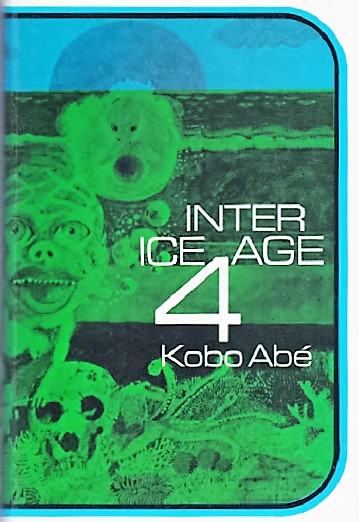
Inter Ice Age 4 by Abe Kobo


Abe's prose has a clinical eye to the detailing and psychology of his characters, the process of how he reveals the scenarios in his novels give them a very controlled momentum, Inter Ice Age 4/Dai Yon Kampyo-ki, one of his earliest novels from 1959 is no exception, perhaps the methodology of his medical training and his experiences in the theatre is shown in his novels. The translation from E. Dale Saunders has aged well, and the novel is complimented with fascinating illustrations from Abe's wife Abe Machi. Like The Face of Another/Tanin no kao, Inter Ice Age 4 has at it's center a scientific experiment, the after effects of it's consequences are uncertain. Inter Ice Age 4 cryptically opens with an underwater eruption, then moves to the scene of passengers on board a ship feeling a slight movement to the water's motion.  Professor Katsumi and his assistant Tanomogi have constructed a machine that can predict the future, at first Katsumi and Tanomogi input financial data and receive predictions about the state of the economy, they plan to showcase the machine using it to predict the next election, but the concerned organisers call it off. Katsumi becomes a celebrity; I anticipated all futures and dispatched villains left to right

As it's revealed that each nation has one of these machines a state of silent stale mate comes about with each side not wanting to upset the economic markets and political balance, the machines act as forecaster-come-spy. Katsumi's superiors begin to question the validity and results of the machine so Katsumi and Tanomogi organise a test cast, and a man chosen at random who they find seated in a restaurant is chosen as their guinea pig, they follow him to a woman's apartment but give up the pursuit. Reading the papers the following morning they discover that the man, (Tsuchida Susumu), had been murdered. Worrying that they maybe incriminated in the case, Katsumi and Tanomogi begin to go over their steps, Katsumi receives a mystery phone call from someone informing him that it will be dangerous to pursue the case, Katsumi recognises the voice from somewhere, but can't remember where. They ignore this call and  manage to obtain Tsuchida's body which they will examine using the machine, they manage to tap into Tsuchida's nervous system  observing through the view finder they see what he saw on the night of his murder, but it brings no results other than discovering the woman's name and also that she had an abortion and that the hospital paid 7000 yen to retain the foetus. Later Katsumi is chased by a man tagging him, theres a scuffle but he manages to make his way back to the laboratory where he discovers one of the assistants Wada Katsuko whose behaviour appears suspicious to Katsumi, she confesses that she and Tanomogi have started a relationship, also that she's willing to offer herself to be examined by the predicting machine. When Tanomogi arrives Katsumi suggests that they let the machine record their conversation for analysis, they find it has been recording already.

Katsumi discovers that his wife has also had an abortion although he discovers that she was drugged, when she came around she found that she had been given 7000 yen in change, she remembers a nurse with a mole on her cheek. The relationship between Katsumi and Tanomogi begins to strain, Katsumi begins to suspect that Tanomogi had in actual fact murdered Tsuchida and threatens to call the police, it's difficult to tell if Katsumi is serious or just testing how Tanomogi will react, Katsumi receives another threatening call. When the machine reports a fault whilst analysing data, Katsumi recognises the voice as the one that has been making the calls, that's your own voice that you programmed the machine with Tanomogi informs him. Another sub plot that emerges concerns Dr Yamamoto's laboratory, Dr Yamamoto is a leading figure in the predicting machine project, and Tanomogi begins to talk of seeing mammals with gills, at first mice and rabbits, then cows and pigs, eventually Katsumi is taken to Dr Yamamoto's submarine facility to view these experiments and discovers that humans are also being bred with gills. The reasons for Dr Yamamoto's breeding program become apparent when geological results show that due to global warming and the melting of the polar regions sea levels will rise, Dr Yamamoto's submarine project is a secret bid for the succession of the species. The novel ends seen from the perspective of an inhabitant of the underwater civilisation who goes in search of the remains of the world that was once lived above the waves, where music was heard through the air and not as vibrations through water.
 
Abe's sustained imaginative narratives weave unexpected correlations between the real world and the ones inhabited by his characters. A portion of the narratives between Katsumi and Tanomogi sees them discussing the implications of viewing the future, and while they pursue Tsuchida they contemplate how he would feel if he were to know that his whole life was suddenly about to be revealed to him. Abe devotes a postscript to this novel contemplating perceptions of the future and present further, I too, therefore, believe that I must understand the future not as something to be judged but something rather that sits in judgement on the present. Abe also views time as being continuous as opposed as being divided solely as present and future, this continuity is cut short for some of the characters in the novel, and Abe leaves it up to the reader and in a way to providence as to whether the novel can be read in hope or despair. 


Monday, 7 September 2009

Beyond the Curve


Trying to get over just how good the 'The Word Book' is, I felt that I wanted to keep going with short story collections, so I thought I'd go with Kobo Abe's 'Beyond the Curve', which includes stories that span from 1951-1966, so covering mainly stories from his earlier output. Abe is well known for his collaboration with film director Hiroshi Teshigahara, who adapted four of Abe's novels. This collection has twelve short stories, translated by Juliet Winters Carpenter, with illustrations by Shiro Tsujimura, and published by Kodansha International in 1991.

Abe is an author that I feel very comfortable to read, maybe I also mean reliable, the abstract and metaphoric in his writing has always fascinated me. I've not read all of his books yet, but I can't recall any that have let me down or failed to 'deliver'. I think I'm deliberately not reading all of his books in order to leave me something of his to read later on. Starting with, 'The Irrelevant Death', where a man returns to his apartment to find a corpse splayed out on his living room floor. Abe drops us in the middle of the conundrum, is this man someone he knows?, how did he get here?, was he murdered here or did the murderer dump him here?, maybe he's being passed from apartment to apartment, around the block. As the man begins to question his links with the deceased, Abe's fascination with a Kafka like enquiry into innocence and guilt, the proof of innocence, incrimination by association, the man hatches a plan to move the body to another apartment, but will it work?.
 
'Dendrocacalia' is the the story of a man named Common, who after suffering a seizure slowly starts transforming into a plant. He receives an invitation card from the mysterious K, who he thinks could possibly be an ex-girlfriend. After arriving at the coffee shop where they are to meet, the only person to arrive is a suspicious looking man. Common doesn't wait around to talk to him and runs away with the man in pursuit, after loosing the man, Common turns to the local library to do some research into his condition. The assistant at the library miraculously turns out to be the man that gave chase, and Common resigns to the fact that he won't be able to escape him, the man hands Common some books, including Dante's Divine Comedy and then Common consults various figures from Greek mythology, Hyacinth, Syrinx, Clytie, maybe his condition is punishment of some wrong doing that he had committed in the past but he can't think of anything. Time passes and Common receives another letter, this time from the Director of the Botanical Gardens informing him that he should read Timiryazev's book 'Life of Plants', which states that scientifically speaking humans and plants are basically the same, and he offers Common, (or by now as he is known Mr Dendrocacalia), a place in their exhibition as day by day Commons transformation is nearing its completion. Common after some consideration, after being told that he is becoming a sort after specimen, and thinking about his own welfare takes him up on his offer.
 
Another element that reappears through Abe's writing is his use of science fiction, but not in an explicit science fantasy way, but uses to illustrate the absurdity of the age that we live in, and I guess you could add to this the absurdity of the planet we live on too!, he also exposes the fact that human beings have quite a small understanding of what makes the universe tick. In 'The Special Envoy' Professor Jumpei Nara is delivering a talk on the 'Outlook for the Space Age' to a group of uninterested students, so uninterested that they walk out of the hall, a man approaches the professor and informs him that he is indeed a Martian, the professor believes that he's just a madman, but carries on listening to the man. The man continues to tell the professor that he is looking for someone to help accomplish his mission, as they want to start constructing landing stations on Earth. He needs someone from Earth to return to Mars with him on a fact finding mission, and then submit their report to the appropriate authorities back on Earth. The man tells how dangerous it has been for Martians in the past to make contact with people from Earth, many of their kind get dragged to insane asylums. After a while Professor Nara's temper caves in, pushing the man aside runs away and phones for the police who come ten minutes later, and take him away. Nara is left thinking, was he or wasn't he really a Martian?.

Characters in these stories seem to be in search of some concrete evidence of existence, be it a name, or an identity. Or some irrefutable piece of reason that they can fall back upon to prove their purpose or existence. Abe seems to return to the theme of identity throughout his books, questioning what it is, why do we need it?, what would the world be without it. The experimentation in his fictions always succeeds in pulling me into the world as seen by his characters, a place I'll no doubt return to.
 
The stories in Beyond The Curve -
 
An Irrelevant Death
The Crime of S.Karma
Dendrocalia
The Life of A Poet
Record of a Transformation
Intruders
Noah's Ark
The Special Envoy
Beguiled
The Bet
The Dream Soldier
Beyond The Curve